
www.industry-australia.com
05
'26
Written on Modified on
Green Ammonia Bunkering Demonstrated at Port Hedland
Fortescue completes Australia's first green ammonia transfer to an ammonia-powered bulk carrier, demonstrating a refuelling approach for lower-carbon maritime transport.
www.fortescue.com
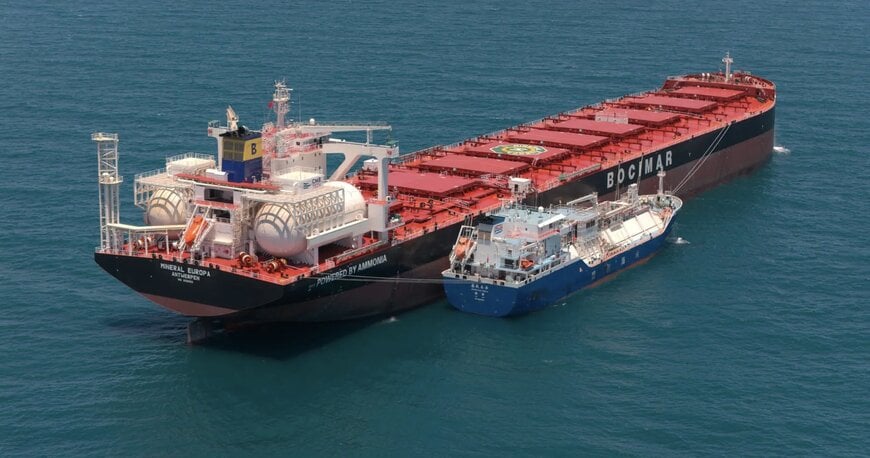
Green ammonia has been transferred to an ammonia-powered dry bulk carrier at the Port of Port Hedland in Western Australia, marking a development in alternative marine fuels and low-emission shipping. The operation involved the transfer of certified green ammonia from a bunker vessel to Mineral Europa, a 300-metre vessel designed to operate on ammonia and used for iron ore transportation.
Ammonia Bunkering for Maritime Transport
The operation demonstrated a practical approach to refuelling ammonia-powered vessels within an operational port environment. Mineral Europa received the green ammonia from a bunker vessel before entering the port to load iron ore.
The vessel is chartered to Fortescue and is intended to transport the company's iron ore to customers in China. The trial therefore connects alternative marine fuel infrastructure with bulk commodity shipping, an application area where vessels require substantial fuel volumes for long-distance transport.
Green Ammonia as an Alternative Marine Fuel
Green ammonia is produced using renewable energy and contains no carbon in its chemical composition. When used as a marine fuel, it does not generate carbon dioxide from the fuel itself, unlike conventional fossil-based marine fuels.
Its use can therefore reduce direct carbon dioxide emissions from shipping. However, the overall environmental performance also depends on the production process, fuel supply chain and vessel technology, including the management of nitrogen oxide emissions and unburned ammonia.
Ammonia Transfer Safety and Port Infrastructure
Ammonia bunkering requires specialised handling procedures because the fuel is toxic and corrosive. Its storage, transfer and use require dedicated equipment, leak detection systems, containment measures and emergency response procedures.
The International Maritime Organization (IMO) approved interim safety guidelines for ships using ammonia as fuel under circular MSC.1/Circ.1687 in February 2025. These guidelines establish safety requirements intended to provide a level of safety and reliability comparable to conventional oil-fuelled ship installations.
The Port Hedland operation provides an operational example of how ammonia transfer can be integrated into existing maritime logistics. Further development of bunkering infrastructure, safety procedures and fuel supply chains will be important for the wider adoption of ammonia-powered vessels.
Edited by Romila DSilva, Induportals Editor, with AI assistance.
www.fortescue.com
