
www.industry-australia.com
21
'26
Written on Modified on
Grid Scale Energy Storage Power Conversion Systems
Jinko ESS and Ingeteam deploy power conversion systems across Australian hybrid and standalone grid projects to resolve integration challenges.
www.ingeteam.com
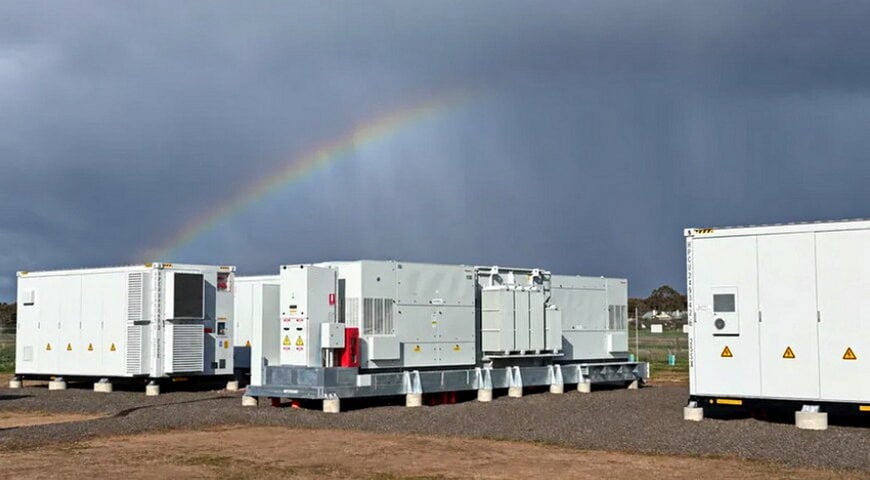
Ingeteam and Jinko ESS collaborated to deploy 65 MW of power capacity and 130 MWh of battery energy storage systems across Victoria, New South Wales, and South Australia. The industrial-scale deployments support utility power grids through both standalone storage assets and direct-current-coupled solar-plus-storage generation facilities.
Industrial Integration Challenges
Grid-tied energy storage demands high operational efficiency, compliance with stringent grid codes, and minimal system footprint. Coordinating photovoltaic generation alongside battery cells requires specialized power conversion architectures to prevent thermal losses, manage bi-directional current, and balance volatile generation profiles against regional grid requirements. To resolve these engineering demands across diverse site footprints, system integrator Jinko ESS combined its storage platforms with high-voltage power conversion equipment from Ingeteam.
Power Conversion Architecture and Division of Roles
Equipment responsibilities divide into platform integration and power electronics engineering. Jinko ESS functions as the overall system integrator, managing battery containment, battery management system interfaces, and balance-of-plant requirements. Ingeteam delivers the power conversion systems, local engineering support, and grid compliance configurations.
The technical deployments implement two distinct power conversion configurations:
For standalone battery energy storage systems, the sites utilize the INGECON SUN STORAGE FSK C-Series HV platform rated at 4.986 MVA AC. Each unit houses two power inverters on a single skid assembly. This compact configuration shortens inter-module cable runs, lowers balance-of-system installation costs, and delivers high-voltage conversion directly aligned with transmission network interconnection requirements.
For the DC-coupled hybrid installations, the architecture connects a central photovoltaic inverter to 16 DC-DC buck-boost converters per installation. Rather than converting power to alternating current at multiple stages, the direct-current bus couples the solar array directly to the storage subsystem. This common DC-bus topology eliminates unnecessary AC-to-DC conversion steps, recaptures potential photovoltaic clipping energy directly into the battery cells, and stabilizes power output through a shared power conversion stage.
Regional Implementation and Technical Support
The installations span utility distribution nodes across southeastern Australia. Ingeteam provides local engineering, technical commissioning, and ongoing field service through its technical operations subsidiary in North Wollongong, New South Wales. This local support structure ensures direct parameter adjustments, field diagnostic validation, and preventative maintenance for the inverter skids and converter modules over their operational lifecycle.
Measurable Grid and Plant Benefits
The combined 130 MWh deployment stabilizes variable renewable generation across three state power networks. By integrating dual-inverter skid architectures and multi-channel DC-DC buck-boost conversion, the participating facilities achieve predictable ramp rates, minimize balance-of-plant thermal dissipation, and reduce site land requirements while meeting local technical network standards.
Edited by Evgeny Churilov, Induportals Media - Adapted by AI.
www.ingeteam.com
